Serving The Steel Industry For Over 45 Years

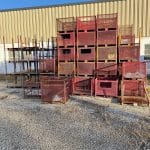
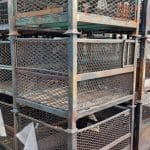
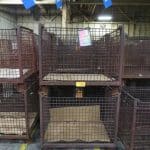
Every basket RDR sells is reconditioned — repaired if needed and fully functional, though not cosmetically like-new. Expect scratches, chipped paint, and dings; these are commercial and industrial storage pieces, not showroom equipment. Stock changes constantly across sizes, mesh gauges, and configurations. Sizing details and a full buyer’s guide are below the listings.
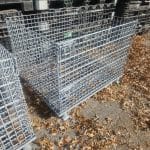
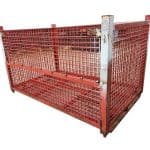
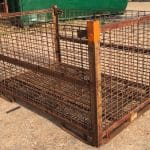


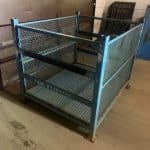




Wire Mesh Baskets: Buyer's Guide
- What "Reconditioned" Means for Wire Mesh Baskets at RDR — what's guaranteed (function) and what isn't (cosmetics)
- Wire Mesh Basket Sizes & Load Capacity: A Buyer's Guide — mesh openings, wire gauge, and floor strength explained
- Used vs. New Wire Mesh Baskets: What's the Real Difference? — cost, condition, and service life compared
- Wire Mesh Baskets by Industry — automotive, produce/agriculture, food & beverage, warehousing, and more
- Shipping Across the Canada–US Border — freight and tariff basics, which apply to baskets and bins alike
Mesh, wire gauge, and floors
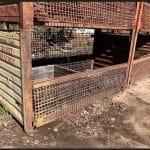
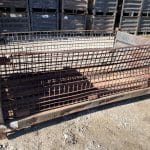
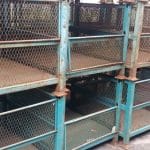
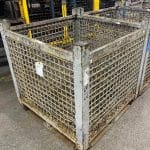
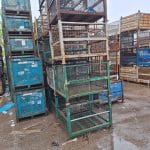
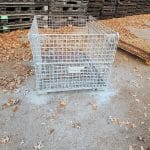
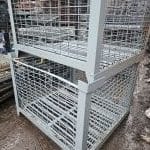
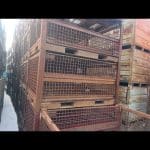
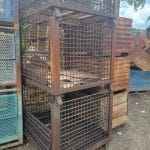
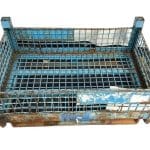
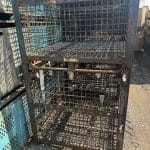
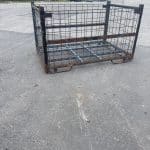
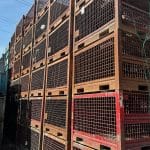
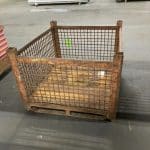
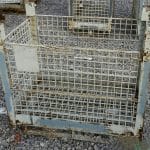
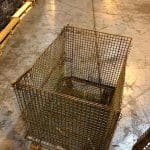
Baskets vary in how much of the structure is mesh. Some have mesh sides and a mesh floor; others pair mesh sides with a solid steel floor. Mesh openings are measured centre to centre, with 2" × 1" and 2" × 2" among the most common. The right opening is the one that holds your parts — anything smaller than the opening will eventually find its way out.
Wire thickness determines how well the sides resist damage in service, and expanded metal is used in place of woven mesh on some units. Many operations have baskets custom fabricated to a specific size and mesh, which is why used stock varies so widely.
Capacity
As with steel bins, capacity comes from the frame and floor rather than the mesh. More cross members under the floor and heavier hollow structural tubing in the frame mean a higher safe load and a longer service life.
Collapsible baskets and return freight
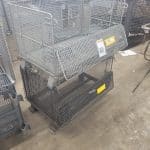
Some baskets are built so all four sides fold down. Empty, they take a fraction of the space in a rack or on a return trailer — which matters when containers cycle back to a supplier rather than staying on site.
Sizing for a 53-foot trailer
Basket dimensions are usually chosen twice over: once for the parts, once for the trailer. Trailer interiors run roughly 99 to 102 inches wide. A 48-inch-wide basket lets two sit side by side across the width; baskets 30 to 33 inches wide let three fit, at 90 to 99 inches total. Height is set so baskets stack two or three high inside the trailer.
How many actually go on a load is a weight question rather than a space question. Legal payload depends on axle count and axle spacing, so a deck of heavy baskets can hit the limit well before the trailer is full.
Handling
Fork entry needs care on mesh baskets. Fork tips driven into the side of a basket puncture the mesh, and a punctured side no longer holds parts reliably. Worth training operators to enter squarely, and worth checking used baskets for previous damage of exactly that kind.
Where they're used
Automotive, produce and agriculture, food and beverage, warehousing, and retail distribution. Mesh is the choice wherever contents need to be visible, drain, or ventilate.