Serving The Steel Industry For Over 45 Years


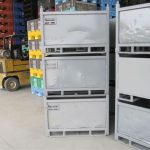
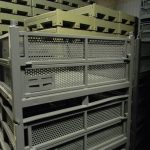
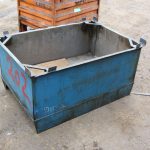

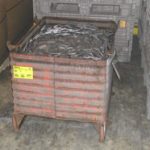




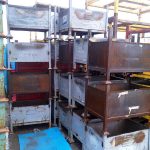
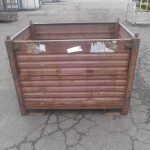
Used Steel Bins: Buyer's Guide
- What "Reconditioned" Means When You Buy From RDR — what's guaranteed (function) and what isn't (cosmetics)
- Steel Bin Sizes & Load Capacity: A Buyer's Guide — gauge, capacity, and dimensions explained
- Used vs. New Steel Bins: What's the Real Difference? — cost, condition, and service life compared
- Steel Bins by Industry — automotive, foundry, manufacturing, scrap, and more
- Shipping Steel Bins Across the Canada–US Border — freight and tariff basics
How solid steel bins are built
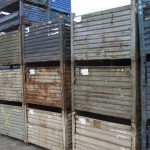
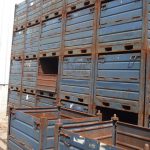
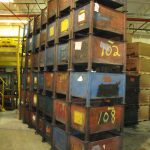
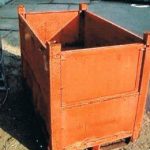
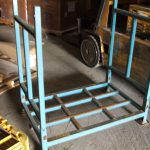
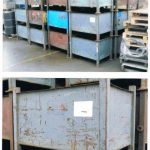
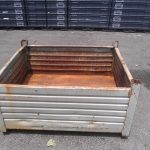
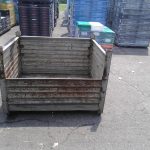
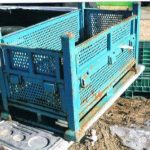
Most solid bins share the same skeleton: four upright posts of hollow structural tubing welded to a framed floor, with cross members under the deck for strength. Sheet metal or corrugated panels are then welded to that frame to form the sides and floor.
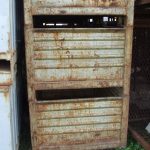
Sheet-metal bins are the general-purpose unit. Most carry one or two half drop gates, which fold down so workers can reach the contents without unloading the bin.
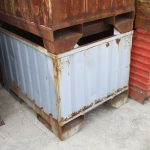
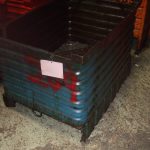
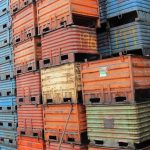
Corrugated bins use folded steel panels in place of flat sheet. The corrugation adds stiffness, which is why these are the usual choice for heavy or hot parts — the panels resist warping under heat and repeated loading.
Capacity and gauge
A bin's working capacity comes down to two things: the gauge of steel in the panels and the construction of the floor. Heavier gauge and more floor cross members mean a higher safe load and a longer service life. Because capacity is set by construction rather than footprint, two bins with the same outside dimensions can be rated very differently — check the listing, and ask if the margin matters for your load.
Runners, fork entry, and stacking
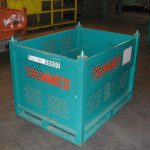
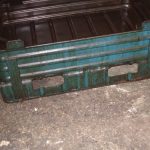
Flat bar welded across the bottom of the corner posts creates runners — the gap between floor and bar that a forklift enters. Runners may sit on two opposite sides (two-way entry) or on all four (four-way entry). They hold the bin on the forks over uneven ground, and they let an operator lift and rotate a bin to empty it at a station or tip production scrap into a roll-off or lugger box.
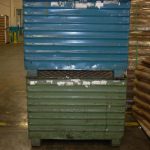
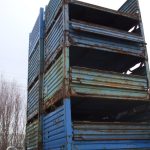
Nearly all solid bins stack. A second style carries a hoop on each of two opposite sides, extending above the top rail — hairpin stacking bins, which nest on those hoops rather than on the rails. Safe stack height depends on how the bin is built and what is in it.
Where they're used
Solid steel bins move parts between stations inside a plant and between facilities for assembly. Automotive is the largest user — fasteners, brake components, pumps, castings, transmission parts, wheels and rims — but foundry, general manufacturing, scrap, agriculture, and warehousing operations run them for the same reason: a container that survives forklift handling for decades costs less over its life than packaging that doesn't.